
On the Cheap: The ~$10 ($CAD) Whole Chicken Rule
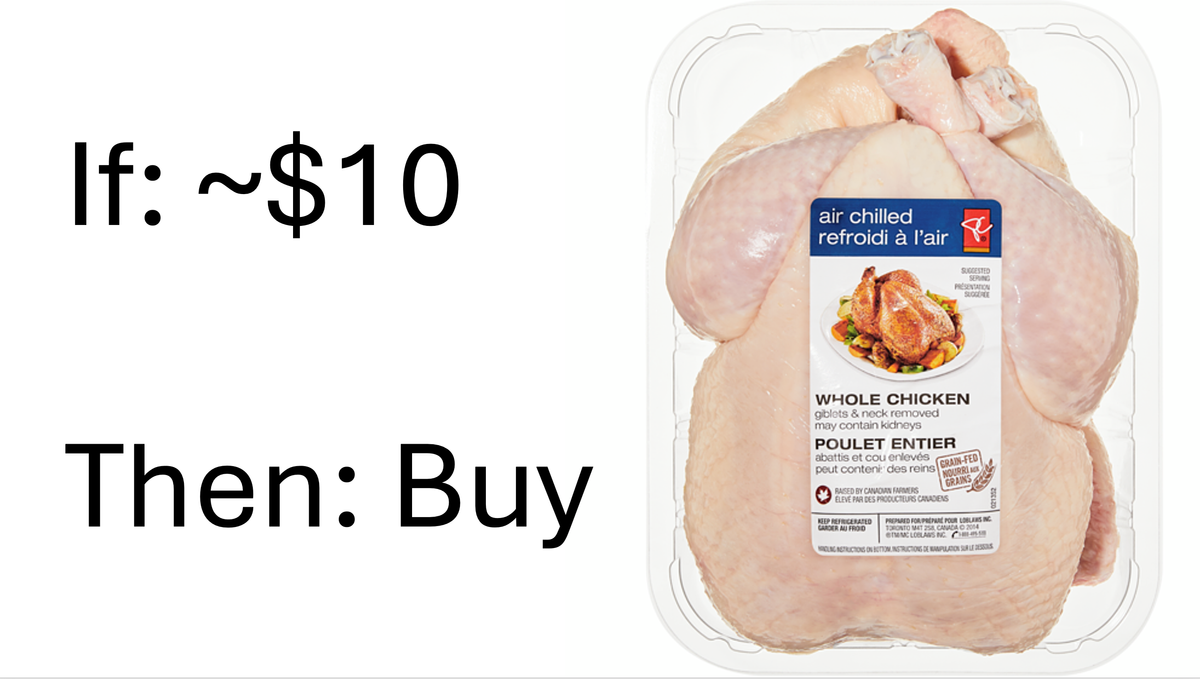
The rule is simple: if you come across a whole chicken whilst grocery shopping, and it's priced at about $10, and you don't already have one in your fridge, you buy it. No planning. No thought. Just buy.
I've decided to pay Ghost $11/month, and so I guess I'm going to try to continue giving this a whirl. And in an effort to "pre-load" some content, I thought I'd share one of my most cherished food-buying strategies: The ~$10 Whole Chicken Rule.
The rule is simple: if you come across a whole chicken whilst grocery shopping, and it's priced at about $10, and you don't already have one in your fridge, you buy it. No planning. No thought. Just buy. Of course, assuming that chicken is a permitted part of your diet.
Inflation Killed My Cooking Plans
Pre-2020, I didn't have The ~$10 Whole Chicken Rule. Pre-2020, I didn't cook spontaneously much. If I was making dinner, I always had a plan, and that plan dictated my grocery store shopping. I was a very happy "planner".
Planned meals and planned shops are great when you can trust in the stability of grocery story prices. There's a beautiful clarity in going to a grocery store knowing exactly what you will purchase, blitzing through the aisles to get your pre-identified goods, while you pass the poor souls who must complete the aisle-by-aisle maze.
I revelled in not being one of those poor souls. But then the pandemic happened, and inflation went berserk.
Take a look at the price of chicken in Canada over the years (as an example), and you'll perhaps notice two trends: 1) it's gotten much more expensive; and 2) the price seems much more variable. This is true of a lot of food items in 2025; prices ain't what they used to be, and you never know what prices you'll find when you walk into a store. And so, if you remain a "planner", you might find yourself staring down a whole chicken that suddenly costs $25, wedded to a plan that is suddenly a lot more expensive that you expected it to be.
And so while I don't remember exactly what date it happened, I know for certain: the post-pandemic inflationary period completely destroyed the meal and shop "planner" in me. Now, I'm an "opportunist".
Cooking Opportunism: A Challenging Money Saver
Variability cuts both ways, and can be your friend if you can tolerate the uncertainty. It means you can walk into a grocery store and find an item might be a wickedly good deal one day, prototypically priced another, or brutally expensive the next. Liberate yourself from your plans, and this means you can save a good amount of money on food as long as you prioritize buying things when they are cheap, and avoiding them best you can when they are expensive.
The trade-off to being a cooking "opportunist" is that you must be prepared to cook whatever item(s) happen to be on sale. This can be challenging to the novice home cook, who may not have much experience cooking in terms of the variety of food products they are familiar with. This is one of my hopes and goals for this blog: to share simple, but wonderful recipes of the varied things I like to cook, in the hopes that you'll join the ranks of cooking opportunists.
And among one of the greatest deals the "opportunist" can find, is a whole chicken that is priced ~ $10.
What's the Deal with Whole Chicken?
Barriers and Solutions
I never was a "whole chicken" person. I always felt like:
- the cooking time and temp was either too long and/or too much guess-work
- the recipes for cooking one were boring, and
- I was very intimidated by the process of carving a whole chicken, once it was ready.
And then, two things changed my relationship to whole chicken:
- My friend Michael kept serving up incredibly delicious whole-chicken meals (often with incredibly tasty sauces), disabusing me of my belief that it was a "boring" product, and
- I finally found a cooking method for whole chicken that felt accessible and reliable
Broth Breakthrough
I'll share these cooking tips, in a moment, but one other feature has really amped up my enthusiasm for whole chicken: the ability to quickly and easily make chicken broth. Homemade chicken broth is way better to cook with than the store bought stuff, but I could never be bothered with the considerable prep and time it took to make it. Then a friend got rid of an Instant Pot, and my buddy Michael gave me a way of "cooking" chicken broth with the Instant Pot where the prep work is < 10 min, and the cook time is < 1 hour (a miracle, for broth).
You might not appreciate how much everyday cooking depends on a steady access to broth, but trust me: you use it everything. Soups (obviously). Sauces. Curries. Rice. Veggies. Everything. Being able to quickly/regularly make broth thereby makes all the rest of your cooking better.
Food Math: ~$10 Whole Chicken vs. Dining Out
Depending on who you're feeding, the size of their appetites, and the size of the bird, you can probably anticipate feeding ~4-5 adults with a whole chicken. Throw in some sort of carb and a veggie or two, and. you're probably looking at ~$5 per adult dinner plate. These days in my neck of the woods, a simple meal out at a basic pub will easily run an adult ~$25-$40 (tip and taxes in).
The broth, then--if you make it--will probably last you a few weeks (maybe a month or two of regular cooking at most).
Whole chickens (at the right price) are astounding value. If you see one ~$10, buy one.
Quick-N-Easy Roasted ~$10 Whole Chicken
I'll do a separate post soon on my favourite cooking content producers, but Andrew Rea, who leads the "Basics with Babish" and "Binging with Babish" (the former, self-explanatory, the latter in which he tries to recreate ridiculous food dishes from TV/Movies) is one of my faves.
And it just so happens, he has a Youtube episode on roasted chicken.
The whole recipe he demonstrates is awesome, and if you're comfortable with it it's well worth a try in its complete form, but if you're just starting out, allow me to simplify further (Note: I will circle back to add pictures of each step the next time I do this):
- Between 1:05 and 2:00, Rea demonstrates a technique called "spatchcocking" It's probably the wildest/weirdest cooking term, but it involves cutting out the chicken's spine with a good pair of kitchen shears (easier than it sounds), flipping the bird over, and pressing down on the bird so that it lays flat.
This helps immensely with ensuring the chicken cooks A) faster, and B) more consistently through all parts of it. - Then, between 2:01 and 2:27, Rea demonstrates a rather aggressive "dry brine": code for "generously*" salt a piece of meat and let it sit for a good amount of time".
This is going to make your meat incredibly flavourful, and help ensure that the skin of your chicken comes out nice and crispy.
*If you use less salt--say a handful--you can skip rinsing the chicken, which helps with crispiness (because water/moisture ruins crisping)
Follow the rest as you like--the herbed butter (amazing, though strange and sometimes finicky) and the gremolata (relatively simple and delicious, and gives you an excuse to buy ingredients that can be used in making broth)--but those two steps alone will ensure a (much) better-than-average roasted chicken (even if you have a tendency to overcook it). From there, it's easy to adapt this chicken for other styles of cooking and/or fancy it up.
Butchering a chicken (after the meat rests, of course), meanwhile, is simply something that takes practice. Try your best on your first one, but choose joy, and don't attempt cuts you aren't comfortable with. For example, I often left the thighs attached to the drumsticks until I became used to the carving. My early birds often left more meat on them too.
Quick-N-Easy Instant Pot Chicken Broth
There's the making the broth, and then there's the storing the broth in a way that it's useful for you for a variety of cooking purposes.
Making Chicken Broth
In your instant pot place:
- A roughly chopped onion (you can even leave the skin on--helps give the broth a nice colour)
- A large carrot (or a couple smaller ones) cut into a few pieces
- 2-3 stalks of celery cut into a few pieces
- The spine from spatchcocking your chicken
- The rest of the chicken carcass after you've carved off what meat you want
- ~1 Tbsp of black peppercorns
- 1 bayleaf
- A (subjective) "bunch" of parsley. If you made gremolata with your roast chicken, throw the rest in. If you bought a bunch and don't have a use for any more, throw all of it in (I have yet to have a chicken broth that had too much parsley)
While steps 6-8 make your broth (much) better, you'll still have a much better broth than store-bought if you just use 1-5.
Press "Start" on your Instant Pot, let it do it's 45 min (+ cool down) thing, and there you have it: homemade broth.
Once it's cooled down, place it in a fridge over night, which will make the fat easier to skim off (there will be a thin "buttery" layer that you can remove, with a larger spoon). It's now ready for use.
Storing Chicken Broth
I usually want two kinds of broth storage options: small and large. For small, I usually dime some broth out in a few ice-cube trays and freeze it that way. For recipes that call for smaller amounts of broth (e.g., sauces, veggies, etc.,), this allows me to quickly use ~2Tbsp of broth at a time (measure your ice cube volume once, as it'll help with quick back-of-the-napkin cooking math). Freeze as many as you like this way (I prefer a greater number of small cubes usually), and store in a freezer bag; you now have broth for days.
For a larger storage option, I usually hunt for yogurt containers. They come in various sizes, but can usually help you store between 1-4 cups--great for soups, stews, and curries which might call for larger amounts.
If a ~$10 Chicken You Spy, Then the Chicken You Must Buy
Though the exact dollar figure of this heuristic won't last forever (purchasing power decreases, forever, by economic design after all), the underlying sentiment will: when whole chickens are unusually cheap, they offer extraordinary value.
And so for now, if you see a ~$10 whole chicken, don't think about it: just put it in your cart, and deal with cooking it later. It'll be easier than you think, provide you with more than you expect, and in the end it'll be a helluva deal.